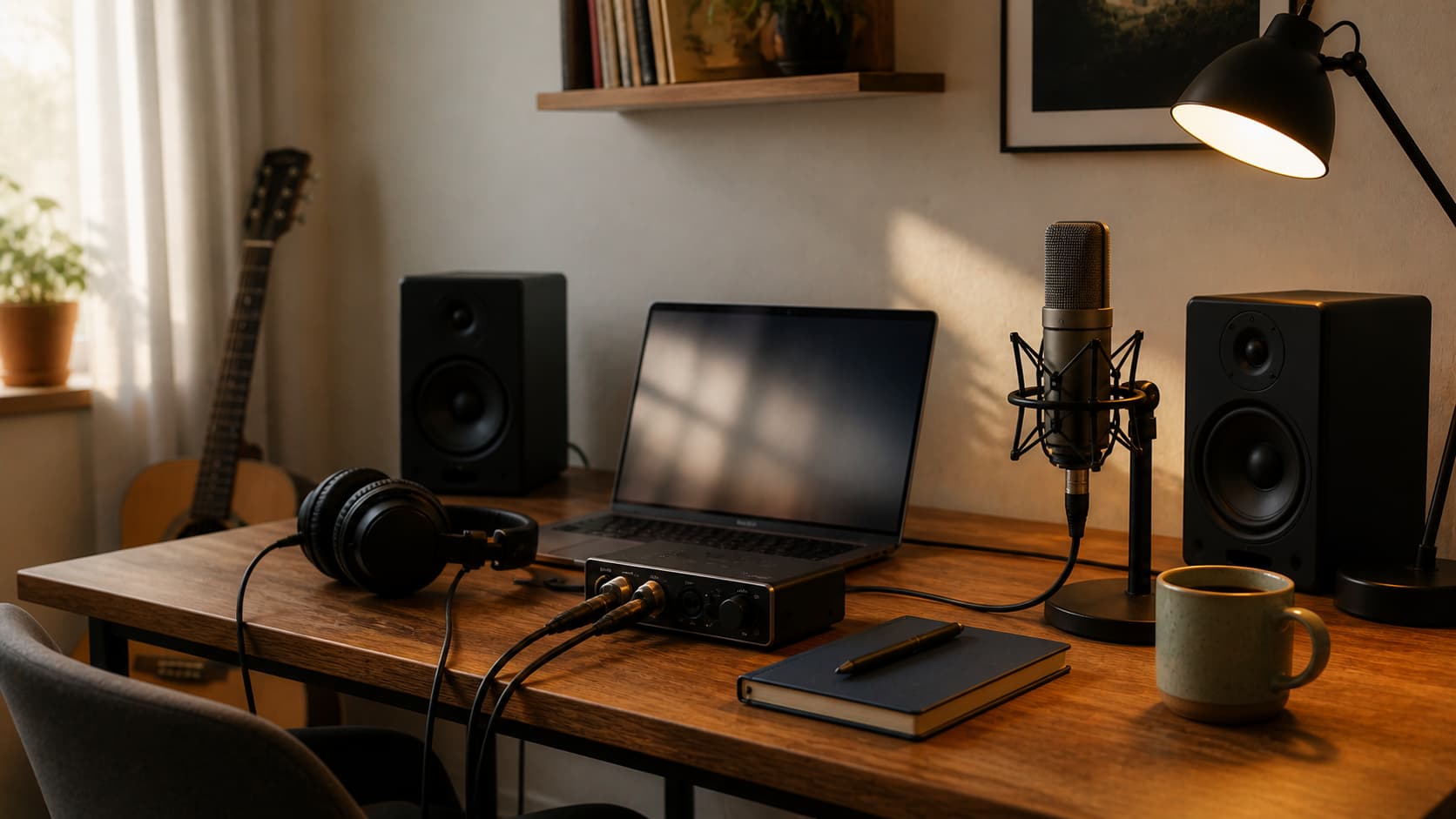
Home Studio on a Budget: What to Buy First
If you’ve spent any time researching “how to start a home studio,” you’ve probably already noticed the problem. Half the guides assume you have £1,500 to drop on the right gear from day one. The other half tell you to buy a £25 USB microphone and “you’re sorted” — which you’re not, and you’ll regret it inside a month.
The honest version is somewhere in between, and it depends on what you’re actually trying to do. Recording vocals for a podcast is a completely different setup from recording an acoustic guitar, which is different again from producing electronic music in a bedroom with a MIDI keyboard. Most beginner guides skip this part and just hand you a shopping list.
Here’s how to think about it instead, in the order that actually matters.
Start with what you’re recording, not what to buy
The single biggest mistake people make is buying gear before deciding what they’re going to use it for. A condenser microphone that’s brilliant for vocals can sound terrible on a guitar amp. An audio interface optimised for solo singer-songwriters won’t help you record a full drum kit. Speakers that sound great for mixing electronic music can flatter rock recordings into sounding worse than they are.
Before you spend anything, answer three questions:
What am I recording — voice, acoustic instrument, electric instrument, or just MIDI / software-based production?
Am I recording one source at a time, or several at once?
Am I doing this in a treated room, a normal bedroom, or somewhere with neighbours through the wall?
The answers determine roughly 80% of what you should buy. Skip this step and you’ll spend twice — once on the wrong thing, once on the right thing six months later.
The actual order to buy things
If you’re starting from absolute zero, this is the order that gives you a working setup fastest, with the fewest expensive mistakes.
1. A laptop or desktop you already own. Don’t buy a new computer for music. Anything from the last five years with 8GB RAM and a half-decent processor will run a basic recording session. The DAW (digital audio workstation — your recording software) doesn’t care whether your laptop is fashionable.
2. A DAW. Many of the best ones are free or cheap. Reaper costs £50 and is what a surprising number of professional studios actually use. GarageBand is free on Mac and is genuinely good. Cakewalk is free on Windows. Don’t buy Pro Tools or Logic just because they’re famous — they’re more software than a beginner needs.
3. An audio interface. This is the box that connects microphones and instruments to your computer. The Focusrite Scarlett Solo or 2i2 (third or fourth generation) is the default beginner answer for a reason — they sound clean, they’re robustly built, and the second-hand market is huge. Budget around £100-150 new.
4. Headphones. Not speakers. Speakers come later, if at all. Closed-back headphones — Audio-Technica ATH-M40x, Beyerdynamic DT 240 Pro, or AKG K72 — are what you actually need first because they let you record without bleed and mix without annoying neighbours. £60-100 will get you something honest.
5. A microphone, finally. And only the right one for what you’re doing. For vocals, podcasts, or singer-songwriter acoustic setups, a Shure SM7B is the famous answer but a Lewitt LCT 240 Pro or Rode NT1 sounds great for a third of the price. For instrument recording, an SM57 is £90 and indestructible. For two-mics-on-an-acoustic-guitar setups, a pair of small-diaphragm condensers like the Lewitt LCT 040 Match.
That’s it. That’s a working studio for £300-450 total, and most of that money is in equipment that holds its value for years.
What you can safely skip at the start
The internet will tell you that you also urgently need: studio monitors, a MIDI keyboard, acoustic foam panels, a pop filter, a reflection filter, a Cloudlifter, vocal booth, a mixing console, plug-in bundles, and three different microphones for “options.”
You don’t. Not yet. Most of those are upgrades for problems you won’t have until you’ve actually been recording for a few months. Buying them now is the audio equivalent of buying every paint colour before you’ve decided what to paint.
The two genuine exceptions are a £15 pop filter (if you’re recording vocals — it’s cheap insurance against plosives) and a basic mic stand (because the desktop stand the mic comes with will pick up every keystroke and laptop fan vibration).
Acoustic treatment is worth doing eventually, but properly — a couple of cheap foam tiles taped to the wall does almost nothing. A duvet draped behind your microphone or recording in a wardrobe full of clothes does more for vocal recordings than £200 of foam.
The room is more important than the gear
This is the part nobody mentions because it’s not exciting and you can’t buy it on Amazon. The room you record in shapes your sound far more than the price of your microphone does. A £900 mic in a tiled bathroom sounds worse than a £100 mic in a bedroom with carpet, curtains and a wardrobe full of clothes.
You don’t need to soundproof anything (which is a different problem — that’s about stopping sound getting in or out). You need to deaden reflections, so the microphone records mostly your voice or instrument, not the room bouncing it back. Soft furnishings absorb sound; hard parallel walls don’t.
In a normal bedroom, the simplest fixes are: record in the corner with the most stuff in it (clothes, bedding, books — all absorb sound), face the microphone toward the most reflective wall (so your back is to soft surfaces and the mic rejects the wall behind you), and don’t record near windows. Doing this with a £100 microphone routinely beats doing none of it with a £500 one.
When to upgrade
Don’t upgrade gear because you’ve finished a project and feel like rewarding yourself. Upgrade only when something specific is genuinely limiting you — and you can name what it is.
Bought a Scarlett Solo and now want to record drums? Now you need more inputs — that’s a real reason to upgrade the interface. Recording vocals professionally and the room noise is showing through? A reflection filter or proper room treatment makes sense. Producing electronic music and your headphones aren’t telling you the truth about the low end? Now monitor speakers earn their place.
Most upgrade urges are gear acquisition syndrome dressed up as need. A useful test: if you can’t articulate the specific problem the new gear solves, you don’t need the new gear. You need to finish more songs.
The realistic first-year setup
A solo musician or podcaster, recording in a normal bedroom, doing roughly the right things, can produce excellent work for under £500 of gear in their first year. Plenty of music you’ve heard on Spotify was recorded that way. A handful of widely-loved albums were recorded for less.
The studio you’re imagining — the wood panelling, the rack of preamps, the acoustic foam — is the studio of someone who’s been doing this for ten years and has earned each upgrade. Trying to skip to that on day one is expensive, and the gear won’t make you better. Recording a lot of songs will.
Start small. Start now. Upgrade when there’s a reason.