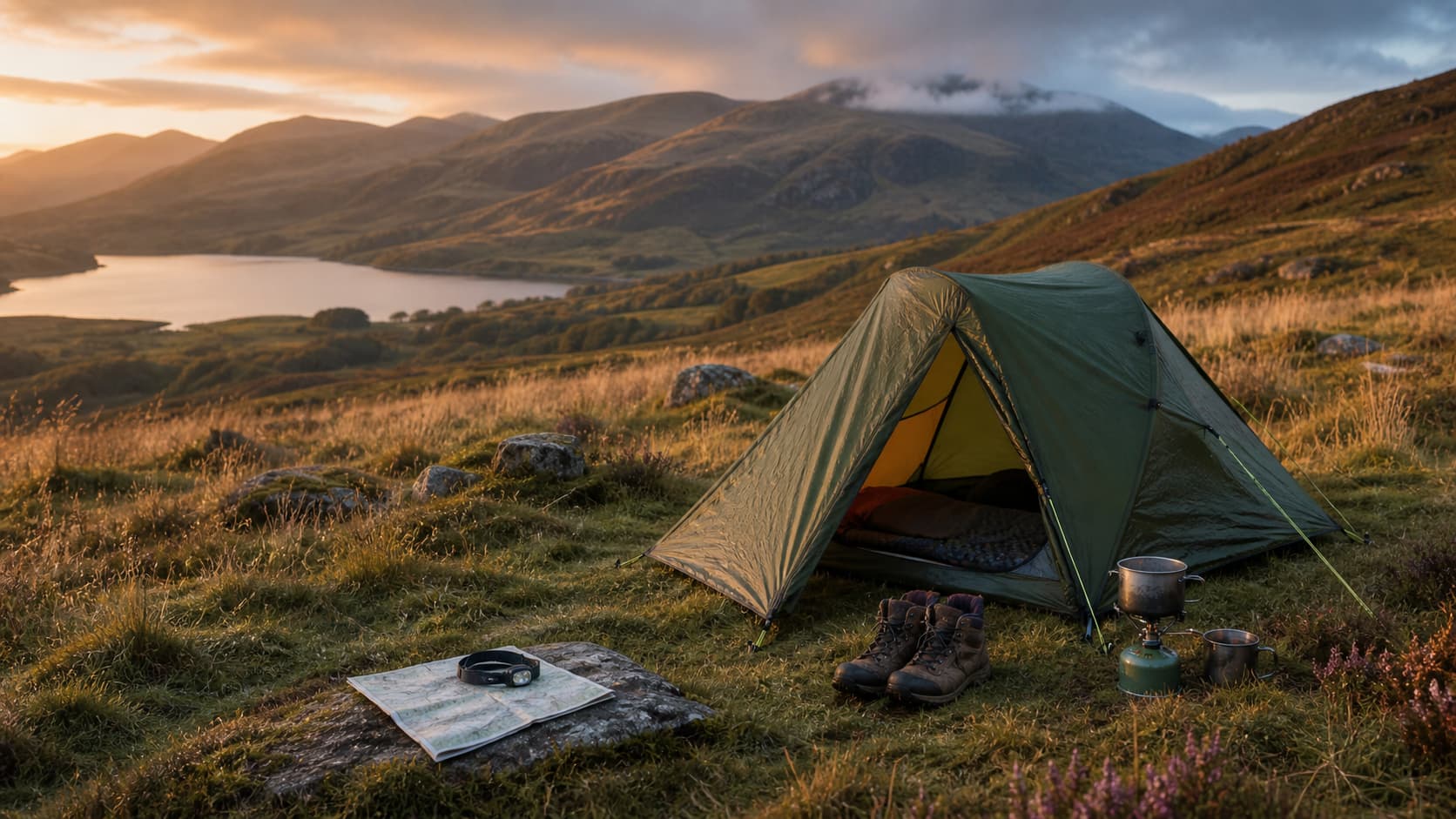
UK Wild Camping: First-Trip Packing Done Right
Most wild camping packing lists you’ll find online have one thing in common — they’re written by people who’ve been doing this for fifteen years and forgotten what it’s like not to know what they don’t know. They tell you to bring a Jetboil and a titanium spork and feel oddly confident you’ll know what to do with them.
The honest version is shorter, cheaper, and starts with the thing nobody mentions first: where you’re allowed to actually do this.
This is for your first proper UK wild camp — one or two nights, in summer or autumn, somewhere reasonable. Not winter. Not Scotland’s North-West in November. Not solo on Crib Goch. We’ll cover the gear, the legal bit, and the small handful of decisions that will determine whether you have a brilliant night or a miserable one.
The legal bit — read this first
Wild camping in England and Wales is, technically, illegal almost everywhere without the landowner’s permission. The single legal exception is parts of Dartmoor, and even that has been litigated recently. In practice, an enormous amount of wild camping happens anyway — quietly, responsibly, above the highest fell wall, leaving no trace, arriving late and leaving early. Most landowners and rangers turn a blind eye to people doing it sensibly.
Scotland is different. Under the Scottish Outdoor Access Code, you have a legal right to wild camp on most unenclosed land, with responsibilities — small groups, leave no trace, avoid roadside spots, don’t camp near houses. There are byelaws restricting it in parts of Loch Lomond and the Trossachs in summer, but the rest of Scotland is genuinely open to you.
The unwritten rules everywhere are the same: arrive late (after 6pm), leave early (before 9am), stay one night per spot, pitch out of sight of paths and roads, take everything out with you including all food waste, and don’t light fires on peat or vegetation. If you do those things, you’ll be fine. If you don’t, you make it harder for everyone else.
The four things that actually matter
Most beginner kit lists run to 40 items. The reality is that four pieces of equipment determine whether your trip is comfortable or miserable. Get these right and the rest is mostly detail.
A tent that handles UK weather. This is the big one. UK upland weather is wet, windy, and unpredictable, and a £40 festival tent will fail you the first time it rains sideways at 2am. You need a proper three-season tent with a full waterproof flysheet rated to 3000mm hydrostatic head minimum, and ideally a structure that doesn’t flap itself to pieces in 30mph winds. The MSR Hubba Hubba and the Vango Banshee 200 are the two most-recommended starter options for a reason. Expect to spend £150-300 if buying new — second-hand on eBay or Gumtree is fine if you check the seams and poles carefully.
A sleeping bag rated for the temperature you’ll actually meet. UK summer nights at altitude can drop to 4-8°C even in July. UK autumn nights can hit 0°C. Look at the sleeping bag’s “comfort” rating, not the “limit” rating, and pick one rated 3-5°C colder than you expect. Synthetic bags are heavier but recover from getting damp; down bags are lighter and warmer but turn into a wet flannel if you don’t keep them dry. For a first trip, a synthetic bag in the £60-100 range is the easier choice.
A sleeping mat with proper insulation. This matters more than the sleeping bag and most people skip it. The cold ground will pull heat out of you all night through the bottom of your bag. You need a mat with an R-value of at least 3 (R-value is just a thermal rating — higher is warmer). The Therm-a-Rest Z Lite is closed-cell foam, indestructible, and £45. Inflatable mats are more comfortable but pop. For a first trip, foam is the safer answer.
Boots that are already broken in. Whatever you do, don’t buy new boots and wear them on a wild camp. New boots plus a 6-mile hike in plus a wet morning out plus another 6 miles back equals blisters that will make you want to give up. Wear boots you’ve already done several day walks in, or wear trail running shoes if your route doesn’t need ankle support — many experienced UK wild campers have moved to trail shoes for everything below the snowline.
The kit that’s genuinely useful
Beyond the big four, here’s what actually earns its place in your pack on a first trip:
A lightweight stove and one pot — gas canister stoves like the MSR PocketRocket are simplest. You don’t need a Jetboil. You’re boiling water, not cooking risotto.
A head torch with fresh batteries and a spare set. You’ll use it more than you expect, especially if you arrive after dark. Petzl Tikka or BioLite HeadLamp are the standard answers.
A 2-litre water capacity, split between a water bottle and a soft flask. Plus water purification — Aquatabs are cheap and reliable; pumps and filters are nice but not necessary for a first trip.
A waterproof jacket and waterproof trousers, even if the forecast is dry. UK weather lies. A pertex-shell jacket from Decathlon for £40 will keep you dry; you don’t need Gore-Tex Pro for one night.
A warm layer for the evening — a fleece or a synthetic insulated jacket. It will be colder than you expect when you stop moving.
A power bank, big enough to charge your phone twice. Phones drain fast in the cold and you’ll want yours working for navigation, photos, and the unlikely event you need to call someone.
A bin bag. For your rubbish, for keeping your kit dry inside the pack, and for sitting on damp grass. Worth its weight ten times over.
A paper map and a basic understanding of how to use it. Phone navigation will fail you exactly when you need it most. OS Explorer 1:25,000 is the right scale for the UK uplands.
That’s it. That’s a working kit list.
What you can leave at home
The internet will tell you that you also need: a camping pillow, camp shoes, a folding chair, a multi-tool, a hatchet, dry bags for every item, a satellite communicator, a Lifestraw, a tarp, trekking poles, a camera tripod, a flask, and freeze-dried meals.
You don’t. Not on a first trip.
A pillow is your spare jumper rolled up. Camp shoes are unnecessary if you’re stopping for one night. A folding chair belongs at a festival. The multi-tool’s only real use is opening a tin you’re not bringing. Freeze-dried meals are fine but expensive — a cheese sandwich and a packet of malt loaf is roughly as good and weighs less. A satellite communicator is sensible for serious trips into remote terrain; for your first wild camp you’ll be within phone signal of somewhere.
The single biggest mistake people make on their first wild camp is bringing too much, not too little. Aim for a pack weight under 10kg total including water. If it’s heavier than that, take something out.
The decisions that matter most
Three small choices will shape how the trip goes more than any individual piece of gear:
Pick a forgiving location. Your first wild camp shouldn’t be a 12-mile epic to a remote ridge. Pick somewhere with road access within 4-5 miles, ideally a route you’ve day-walked before, with a confirmed camping spot you’ve identified on the map (above the highest field wall, sheltered from the prevailing wind, near water but not next to it). The Lake District, Yorkshire Dales, Brecon Beacons and the Cairngorms all have well-known beginner-friendly spots — search “wild camping” plus the area name and you’ll find them.
Check the weather honestly, twice. Mountain Weather Information Service (MWIS) is the best UK forecast for upland areas and it’s free. If MWIS is showing 50mph winds or persistent rain, postpone. Your first wild camp doesn’t need to be heroic. The point is to come back wanting to do it again, not wanting to never do it again.
Tell someone where you’re going. Send a friend or family member your route, your planned pitch location, your expected return time, and what to do if they haven’t heard from you by then. This takes two minutes and is the single most important safety thing you can do.
What it actually feels like
Here’s the part nobody tells you: the first hour after pitching is the best part of the entire trip. You’ve made it to your spot, the tent is up, the stove is purring, the light is fading on the hills, and you’ve got nowhere to be. Most people describe their first wild camp as the calmest they’ve felt in months. That’s the actual reason to do this.
The night itself is harder than you expect — sounds you don’t recognise, the tent flapping, sleep that comes in patches. The morning is harder again — packing wet kit, cold hands, knees that creak. And then at some point on the walk out you’ll realise you want to do it again, and you’ll start planning the next one before you’ve reached the car.
Pack light. Pick somewhere kind. Tell someone. Go.